Nurturing Roots, Expanding Horizons, Empowering Young Minds
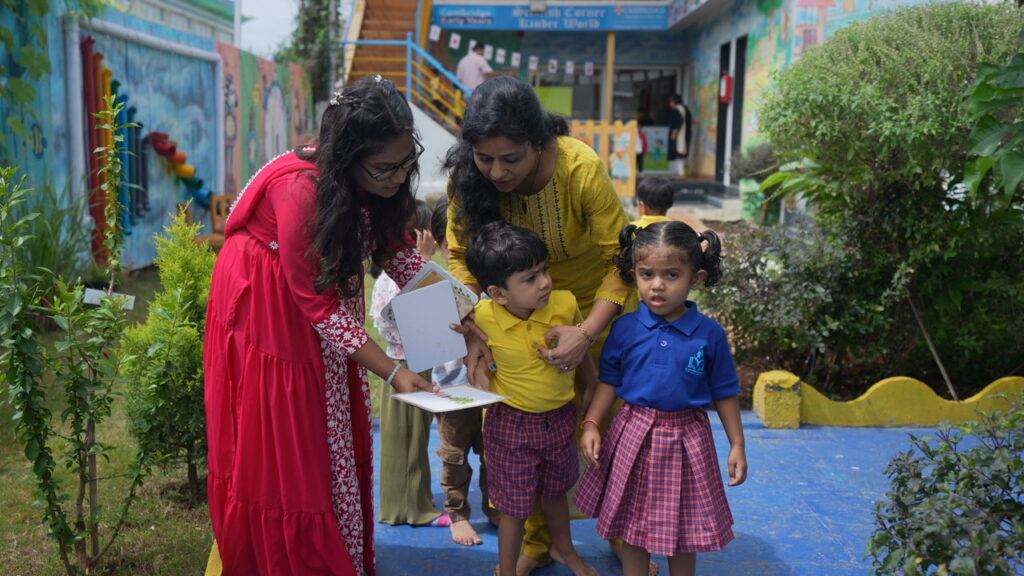
At Scottish Corner Kinder World (SCKW), learning is not confined to textbooks or timelines. It is a carefully curated, dynamic journey that unfolds at the intersection of Indian values, global pedagogical excellence, and child development science.
Our curriculum is shaped by the vision of NEP 2020, enriched by international frameworks such as EYFS (UK), Te Whāriki (New Zealand), and NAEYC (USA), and brought to life through warm, stimulating environments that empower every child to explore, connect, and thrive.
We believe that a meaningful education honours each child’s pace, purpose, and potential. It is not just delivered — it is lived, played, experienced, and shared.
National Education Policy (NEP) 2020, internationally acclaimed early childhood pedagogies, and developmental neuroscience, all thoughtfully adapted to the Indian socio-cultural milieu.
We honour the individuality of every learner, embracing their pace, preferences, and personal growth pathways. Our approach is not about delivering content — it’s about co-constructing learning through play, inquiry, and authentic experience.
At Scottish Corner Kinder World (SCKW), our curriculum goes beyond books and blackboards. It is a thoughtfully curated blend of NEP 2020 guidelines, global early childhood pedagogies, and developmental neuroscience, all adapted to the Indian cultural context.
We believe every child deserves an education that respects their pace, passion, and personality. That’s why we don’t just follow a curriculum — we live it, play it, and grow through it.
Curriculum Highlights
Play-Based and Child-Centered Learning
Grounded in research and best practices from across the globe, we embrace active learning as the foundation of early development. Our learning spaces are intentionally curated to support experiential engagement through:
- Dramatic play, narrative development, and symbolic representation
- Structured and unstructured fine and gross motor challenges
- Expressive arts including music, visual art, dance, and creative movement
- Multi-sensory materials designed for open-ended exploration and innovation
Developmentally Responsive Framework
The curriculum is structured in alignment with age-appropriate learning trajectories, informed by international benchmarks such as the Early Years Foundation Stage (EYFS – UK) and NAEYC guidelines (USA). Children progress holistically across the following core domains:
- Cognitive flexibility and higher-order thinking
- Receptive and expressive language development
- Emotional intelligence and interpersonal awareness
- Sensorimotor refinement and physical wellness
- Aesthetic expression and imaginative fluency
International Pedagogical Inspirations
While firmly rooted in Indian ethos, our methodology integrates leading global approaches to enhance educational depth and perspective:
- Montessori: Emphasis on purposeful independence, tactile exploration, and order in the environment
- Reggio Emilia: Inquiry-based learning, child-led project work, and learning documentation
- Waldorf: Deep learning through rhythm, artistic integration, and nature-based routines
- J. Krishnamurti’s Approach: Promoting inner awareness, mindful presence, and reflective engagement
Phonics and Multilingual Language Development
Our proprietary phonics program, developed through the lens of multisensory and evidence-based instruction, builds strong foundational literacy. Through active engagement, learners:
- Develop early decoding and sound-symbol association
- Gain confidence in spoken English while embracing linguistic diversity
- Cultivate a love for oral storytelling, narrative construction, and book-based learning
Conceptual Learning Through Integrated Themes
Thematic and seasonal cycles shape our curriculum, encouraging children to discover and connect with the natural world and their cultural surroundings. Themes are interdisciplinary, touching on:
- Environmental stewardship (e.g., water, earth, sky)
- Cultural literacy (festivals, food, family life)
- Scientific thinking (seasons, life cycles, change over time)
Life Skills and Core Human Values
Character formation and social consciousness are embedded across the day. Drawing inspiration from Social and Emotional Learning (SEL) frameworks and 21st Century Competency Models, our learners cultivate:
- Empathy, gratitude, and mindfulness
- Conflict resolution, cooperation, and active listening
- Personal hygiene, safety, and independent routines
Cultural responsiveness and civic awareness Learning Progression by Age Group
Playgroup (1.8 – 2.5 years)
Focus: Secure attachment, sensory exploration, and early communication
Description:
This is the gentle beginning of a child’s formal learning journey. At this stage, we prioritise emotional security and routine. The environment offers soft transitions, bonding rituals, and multi-sensory activities to strengthen neural pathways. Educators engage in responsive caregiving while fostering basic language sounds, object permanence, and motor exploration.
Key Experiences:
- Music, lullabies, and repetition-based language routines
- Free movement zones with tactile and gross motor challenges
- Visual tracking and auditory response activities
- Guided parallel play to support early social awareness
Nursery (2.5 – 3.5 years)
Focus: Peer interaction, gross and fine motor development, foundational communication
Description:
This stage is about social identity and early self-regulation. Children begin to enjoy collaborative routines, show preferences, and initiate interactions. Educators scaffold learning through guided conversations, rhythmic rhymes, sorting tasks, and cause-effect play. Children develop hand-eye coordination, word acquisition, and rule-based play behaviours.
Key Experiences:
- Group storytelling, finger plays, and rhythm games
- Colour and shape recognition with real-world objects
- Introduction to class responsibilities and structured routines
- Early mark-making (pre-writing strokes) and grip-based play
Junior KG / LKG (3.5 – 4.5 years)
Focus: Emergent literacy and numeracy, emotional vocabulary, symbolic thinking
Description:
At this phase, children enter a world of representational thought and emerging academic readiness. Our program integrates structured phonics, basic numeracy, and collaborative learning while nurturing imagination. Learners engage in theme-based inquiry, pattern recognition, and reflective listening, which build early critical thinking and self-awareness.
Key Experiences:
- Blending and segmenting sounds in playful phonics games
- Counting objects, comparing sizes, identifying patterns
- Role-play scenarios that support conflict resolution
- Nature-based learning: gardening, weather journals, animal tracking
Senior KG / UKG (4.5 – 5.5 years)
Focus: Conceptual readiness, independent learning, executive functioning
Description:
This is the bridge to formal schooling. Children begin engaging with multi-step tasks, early writing, logic-building games, and cooperative problem-solving. Emphasis is placed on phonics fluency, mathematical reasoning, journaling, and stage confidence. They build resilience, refine social skills, and develop confidence in making choices and expressing ideas.
Key Experiences:
- Sentence formation, word families, and storytelling journals
- Number operations using the Concrete–Pictorial–Abstract approach
- Mini science experiments to explore cause-effect relationships
- Speaking opportunities: Show & Tell, assemblies, puppet theatre